Japan Prep Guide
Onsen Etiquette for First-Timers: Rules, Tattoos and Private Baths
Some links on this page earn us a small commission at no extra cost to you. How that works.
Shy, or have tattoos?
Book a room with its own bath
- Many ryokan and hotels offer en-suite onsen included in the room price
- Private 'kashikiri' baths usually cost extra and need a reservation
- Room baths skip the tattoo question entirely
Opens Klook in a new tab. Affiliate link: we may earn a commission; your price is the same.
A Japanese onsen (hot spring bath) is one of the best parts of a winter trip, and the rules are simpler than they look. Most first-timer worries come down to three questions: do I really have to be naked, what do I do with the little towel, and will my tattoo get me turned away? This guide answers all three, step by step.
Quick answer: bathe fully naked (no swimsuit), wash your whole body at the shower stools before getting in, keep the small towel and your hair out of the water, stay quiet, and don't stay in much longer than about 30 minutes. With tattoos, rules differ by facility: check before you go, pick a tattoo-friendly town such as Kinosaki Onsen (all seven public baths accept tattoos of any size), or book a room with its own bath.
Opens Klook in a new tab. Affiliate link: we may earn a commission; your price is the same.
Onsen etiquette step by step
| Step | What to do | Common mistake |
|---|---|---|
| 1. Choose the right curtain | Most public baths are split by gender; the curtain is usually blue for men and red for women, often with the kanji 男 (men) and 女 (women) | Walking in by color alone: check the kanji, as some baths swap sides by day |
| 2. Undress in the changing room | Put everything in a locker or basket; take only the small towel | Wearing a swimsuit or underwear into the bath |
| 3. Wash first | Sit at a shower stool and wash your whole body; shampoo and body wash are almost always provided | Rinsing quickly while standing, or splashing neighbors |
| 4. Enter slowly | Lower yourself in gently; keep long hair tied up | Diving, swimming or putting your head under |
| 5. Towel out of the water | Rest it on the edge or fold it on your head | Dipping the towel into the bath |
| 6. Keep it short and calm | About 30 minutes at most; drink water afterwards | Bathing after drinking alcohol |
| 7. Dry off before the changing room | Wipe yourself with the small towel so you don't drip on the floor | Walking in soaking wet |
Do you have to be naked in an onsen?
Yes, in almost all of them. The Japan National Tourism Organization (JNTO) explains that most hot springs ask you to bathe fully naked, both to keep the water clean and in the spirit of "skinship", the idea of relaxing together without barriers. The exceptions are a few theme-park-style spa complexes, which say clearly when swimsuits are allowed.
If being naked in front of strangers is the deal-breaker, you still have options (see private baths below). Nobody stares in a Japanese bath; locals are there to relax, and quietly following the routine is all anyone expects of you.
The small towel, hair and valuables
- The small towel is for covering up as you walk and for washing. It never goes into the bath water. The large bath towel stays in the changing room.
- Hair: JNTO says even freshly washed hair counts as a contaminant. Bring a hair tie if your hair is long and don't put your head under.
- Jewelry: take it off. Depending on the minerals in the water, metal can discolor.
- Phones and cameras: never use them in the changing or bathing areas, where other people are undressed.
- Food and drink: not in the bath. Water coolers in the changing room and a cold milk from the vending machine afterwards are the classic way to finish.
Onsen with tattoos: what are the rules?
There is no national law; each facility sets its own rule. Historically, tattoos in Japan were linked with criminal groups, which is why many baths still post "no tattoos" signs. The most-quoted figure comes from a 2015 Japan Tourism Agency survey: of 581 hotels and inns that answered, about 56% said they refused guests with tattoos in their shared baths. That survey is old and had a low response rate, but it tells you the honest picture: some places say no, many say yes, and you need to check each one.
Your options, from easiest to hardest
- A room with its own bath. No tattoo question, no strangers. See the next section.
- A tattoo-friendly town. Kinosaki Onsen's official site says all seven public bathhouses accept tattoos of all sizes with no need to cover them; the baths inside individual ryokan may have different rules, so ask your inn. Kinosaki is about 2.5 hours by train from Kyoto and Osaka. JNTO's list of tattoo-friendly onsen also includes Dogo Onsen in Ehime (all three bathhouses), Otakinoyu in Kusatsu (Gunma) and Yamato-no-Yu in Chiba, about 40 minutes from Narita Airport (primary-school age and older only). Policies can change, so check each official site before you go.
- Cover a small tattoo. Some facilities accept a small tattoo hidden under a skin-colored cover sticker. Only do this where the facility says covers are accepted; don't try to sneak a large tattoo past a "no tattoos" rule.
Kinosaki Onsen's tattoo page (official) (opens in a new tab) · JNTO: tattoo-friendly onsen in Japan (opens in a new tab)
Private onsen: kashikiri baths and rooms with an open-air bath
JNTO describes three private choices. A kashikiri bath is a shared bath you rent for a set time; it almost always costs extra and you reserve it in advance or at the front desk. A room with an en-suite onsen, often an open-air tub on the balcony, is included in the room price. And free ashiyu foot baths, found near stations and in onsen towns, need no undressing at all.
For first-timers, couples, families with children of mixed genders, travelers with tattoos and anyone uncomfortable with shared nudity, a room with its own bath is the stress-free choice. Hakone is the easiest onsen area to reach from Tokyo, so it has many inns and hotels where some rooms come with a private bath. Room types and prices change by date, so filter by "private bath" or read the room description before you book.
Compare Hakone hotels and ryokan on Klook (opens in a new tab)
Planning a day trip rather than a night? Our Hakone day trip guide covers the Freepass and this winter's ropeway closures, and the Hakone transport pass on Klook (opens in a new tab) bundles the local trains, cable car and boat.
Onsen, ryokan, sento or day spa: which one?
| Type | What it is | Good for |
|---|---|---|
| Onsen (day-use bathhouse) | Natural hot spring water; pay at the door | Trying an onsen without staying overnight |
| Ryokan or hotel onsen | Shared baths are almost always free for overnight guests; many also open to day visitors for a fixed fee | Bathing at night and early morning when it's quiet |
| Kashikiri / en-suite bath | Private bath, rented by the hour or included with the room | Couples, families, tattoos, shy first-timers |
| Sento | Neighborhood bathhouse with heated tap water, not spring water | Same etiquette in the middle of a city |
| Ashiyu | Foot bath, usually free | A taste of the hot spring with shoes and socks off only |
Winter onsen trips worth planning
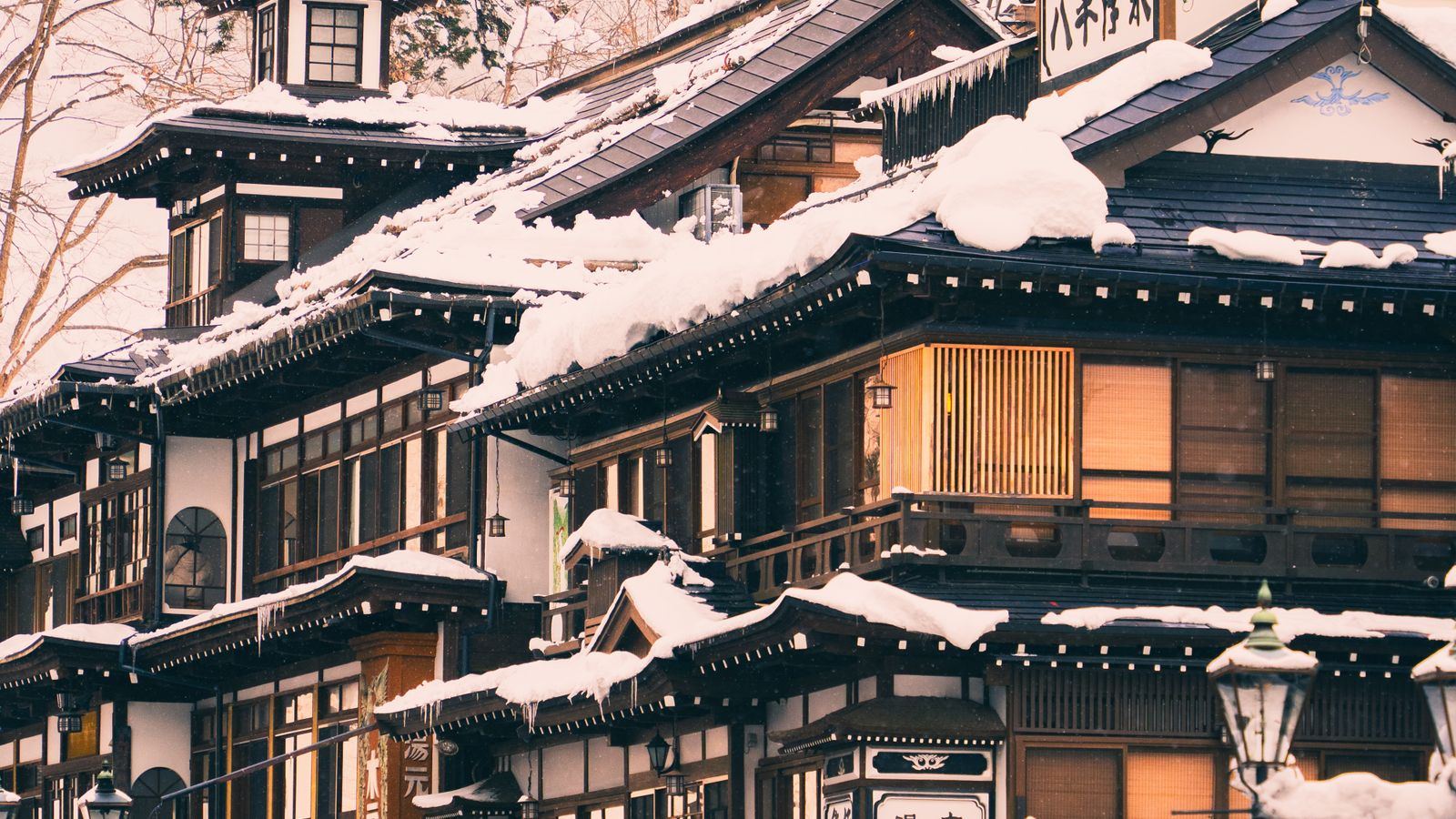
Snow and steam are a famous combination; JNTO calls the snow-view baths "yukimi" onsen. If you are planning one this winter, Ginzan Onsen needs the most preparation: day visitors ride a reserved shuttle from December 19, 2026 to March 7, 2027, and the town's ryokan fill up early, so compare Ginzan Onsen stays on Klook (opens in a new tab) before you fix your dates. For what to wear between baths and the cold walk back, see our Japan winter packing list, and for the bigger picture, Japan in winter.
Onsen FAQ: questions first-timers ask
Can I wear a swimsuit in an onsen?
Not in a traditional onsen. Only some spa complexes and mixed-gender baths that say so allow swimsuits or bathing wraps. If you want to stay covered, book a private bath.
Can I go to an onsen during my period?
Shared baths are best skipped on heavy days for hygiene reasons; a private or en-suite bath is the comfortable alternative.
Can children go in?
Usually yes with a parent, but some facilities set age limits (Yamato-no-Yu, for example, admits primary-school age and older). Young children of the opposite sex are often allowed in with a parent up to a certain age that each facility decides.
What should I bring?
Many baths provide towels, shampoo and hair dryers; small day-use bathhouses may charge for towel rental. A hair tie, a coin for the locker and water for afterwards cover the rest.
Is it OK to talk in the bath?
Quiet conversation is fine. Loud talking, phone calls and splashing are not.
Bottom line
Wash first, keep the towel and your hair out of the water, stay quiet and don't stay in too long; that covers most of onsen etiquette. If tattoos or shared nudity are a concern, choose a tattoo-friendly town like Kinosaki or a room with its own bath, and check each facility's rule on its official site before you travel.
Related guides
Save this guide for later